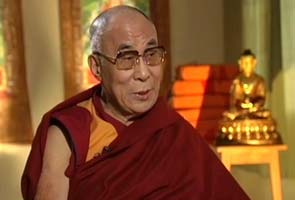
New Delhi:
 On
Your Call, Dalai Lama takes on some questions from across the
country, including one from Narayana Murthy of Infosys. Below is the
full transcript of the interview.
NDTV: Traditionally we
celebrate the arrival of a new year, but in the beginning of this new
year, India is a country united in grief and anger against the brutal
rape of a young girl. On this special episode of Your Call I am joined
by a very special guest, the one man who can perhaps give us some sense
of peace as we try to comprehend the brutal happenings around us, the
Dalai Lama. It's a time when in India there is a great sense of grief
and anger because of what happened to a young girl. What would your
message be Your Holiness, at a time like this?
Dalai Lama: Of
course, firstly, such incidents are really very sad, very sad. Now India
is a huge country and with long history. I think a very civilized
culture heritage. India had a culture of non-violence, Ahimsa, at least
two to three thousand years ago. They had in modern times during freedom
fight, difficult period. The Indian leaders follow thousand years' old
principles, then also, religious harmony on the basis of mutual
understanding is also very much alive. So now I think overall picture of
India, I think the material development with modern education
increasing or developed, then it's very helpful, but at the same time
particularly people must pay more serious attention. You see the
modernisation including education and thousand years old your own
traditional values, these things are the basis of moral principal. Now
that is lacking. I think they are neglected. Now over 53 years India is
my home now. So big towns, big buildings, a lot of cars, lot of
facilities are much improved even in my own place Dharamshala. Over 50
years it is much changed, but in meantime like these incidents and also
lot of corruptions, injustice of activities here and there. Now people
particularly people must think more seriously how to keep your thousand
year old tradition. Basically the human values, these are very
important.
NDTV: As a society, how do we regain our moral
compass? I have some questions Your Holiness from some young protestors
who wanted to ask you some questions. Let's hear what they have to say
Question
1: Right now in the situation where this girl has died a terrible death
because of her horrendous rape. The public is baying for their blood,
How do we argue with them against the death penalty which I'm against
and which I think you as a Buddhist are also against?
NDTV: We see so much anger. People want the death penalty. How do we convert this anger into something constructive?
Dalai
Lama: Actually, my own sort of belief since I think few decades some
international organisations started a movement banning the death
penalty. I'm one of the signatures so that's my basic stand, but then in
case to case countries are putting their own law. So you have to deal
according to your own law.
NDTV: You of course you have signed
and Buddhism is against violence and you are against the death penalty.
Leaving aside the issues of laws in India, many have argued that the
death penalty can be a deterrent or it will make sure that crimes
against women come to an end or it can work as the extreme punishment.
They have cited the Middle East and Arab countries where the crime rate
is much lower. Why are you against the death penalty?
Dalai
Lama: Firstly because life is precious so ahimsa means respect for
precious life so don't harm. That's the idea of Ahimsa. So according to
that if you shorten life, it's not good and also it's a form of violence
but in particular circumstances like abortion, basically it's the form
of violence. So we should not do it, we should not implement the death
penalty. Sometime back I think in Tihar jail the lady police tried to
introduce some meditation.
NDTV: Kiran Bedi?
Dalai Lama:
Yes. So that's the proper way. Death sentence means it's the punishment
physically. It won't help. Look the violent method everywhere all over
the world. Sincere motivation is a good goal. The result of violence is
always complicated. So, therefore, education and also educate these
criminal people. Let them eventually realize their own mistake. Very
negative individual through awareness and more education eventually
become very good citizen. So that's the proper way. That's my view.
Question
2: How do you keep your faith in the fundamental goodness of human
beings when horrible things like this are happening all the time and we
cannot do anything to stop them?
Dalai Lama: Seven billion human
beings, if all seven billion human beings do this kind of thing then I
will lose my faith. Perhaps I think 95 per cent of human beings still
have human nature, affection, sense of concern about others well-being,
still there are. Now only thing we should do is make awareness. Respect
others' life, helping other people is actually the best way to fulfill
your own happy life. Harming other people, bullying other including
raping will destroy your own good future life. So, therefore, all these
depend on awareness, education.
NDTV: We focus so much of course
on the problem in India right now, but I also have questions from some
young Tibetans for you, so let's just hear what they have to say
Question
3: My question to His Holiness The 14 Dalai Lama is that Tibet was an
independent nation and now it's not an independent nation. Is there a
possibility of seeing an independent nation in the near future?
NDTV: Many young Tibetans want independence.
Dalai
Lama: Yes. Historically Tibet is a separate nation. There is no
question but look at the future. Firstly, look at the spirit of European
union, common interest is more important than individual because
individual's interest very much link with common interest. So one time
Vinoba ji, he once expressed concept of ABC, that mean A Afghanistan, B
Burma, C, Sri Lanka, then India, Pakistan. All these countries should
set up some kind of pattern. So these are, I feel, long term, long run
realistic approach, if that kind of idea materializes, then Afghanistan
today will be much stable and also Bangladesh and Pakistan. So,
therefore, yes we are a separate nation but not necessarily just insist
on that. Let us try to build new kind of genuine union. If that fails
then it's something different. So far our middle approach brought lot of
support from Chinese people, mainly Chinese intellectuals. After 2008
crisis we noticed over 1 thousand articles in Chinese language written
by Chinese. All fully supported our middle approach and very critically
about their own government policy. In anyway, support from Chinese
people, from Chinese intelligence is very necessary. Emotionally many
young people say, "oh we want independence" they never show us how to
achieve independence step by step. How much support from Chinese people,
how much support from Indian government? How much support from European
union, how much support from the United States? Thinking realistically
is important. Saying independence, independence is not easy.
NDTV: Are you optimistic about the new Head Premier Xi Jinping? Are you optimistic?
Dalai
Lama: Too early to say but for their own interest they have to follow
more realistic approach. Using force is outdated, more violence, more
suppression, more resentment, that's logical. Therefore, I'm quite sure
the new leadership, with help of these intellectual people, has to
follow, as things are being stated, seeking truth from fact sooner or
later the more realistic approach. The so-called minorities problems
like Tibetan problem, Mongolian problem some other problem, they follow
more realistic approach, more realistic approach and basically equal
terms. Most times he emphasised equality. He always said against Han
chauvinism. In recent decades that word disappeared.
NDTV: Even
though you retired in a sense, whatever you say is still held as the
word of God in a sense for the entire Tibetans and many have asked about
the issue of your succession, and China has made it very clear they
want to decide. You have said that let us see what will happen, the
process of reincarnation. Some may say that you even appoint somebody
before your death, which has never happened before. What is your view on
this?
Dalai Lama: 2-3 years ago I made it very clear after
thorough discussion with head of Tibetan Buddhist tradition, different
tradition. Occasionally we gathered; we discussed about future of Dalai
Lama institution or re-incarnation. Then I think two years ago we made
one statement with full consensus with leaders that the essential thing
is around my age, around late 90's then I will discuss with people and
finalise. One time in America some media asked me about my reincarnation
then I took my glass and looked at his face and said my reincarnation
is quite a hurry or not much? Then he said no hurry.
NDTV: No hurry at all, but of course you said who knows, may be it's a woman, that may be a nice break
Dalai
Lama: Actually as early as '69, in my formal statement I mentioned the
very institution of Dalai Lama should continue or not is up to Tibetan
people that's the principle. After 10 years or 15 years if the situation
is such that the majority of Tibetan people feel now Dalai Lama
institution is no longer much relevant, then the institution
automatically will seize. In case majority of people want to keep this
institution then the question how to carry the successor, that also is,
either as you follow the traditional way or some senior sort of Tibetan
Lamas, they are sort of successor and reincarnation also, you see in
Tibetan history, even today this is some reincarnated Lama you see
actually appointed by the previous life while still alive. So you chose
through investigation, mystery way of investigation, then they found
some children quite fit for their successor and then appoint. That's
also possible.
NDTV: But China will make this an issue of control.
Dalai
Lama: That I think is mainly a political reason now that I already
retired. Quite popular fourteenth Dalai Lama also now retired already,
so fifteenth Dalai Lama you see they're not so important in political
field. So then their interests actually don't much reasons. In the past
there was some Chinese emperor, actually showing interest about some
high Tibetan Lama's. At that time the Emperors themselves are Buddhists,
some Emperors actually receiving teaching from some Tibetan Lama, so
some spiritually special relations. So then naturally when Dalai Lama
passed away, the disciple, she's showing some interest, some
involvement, that's natural, you see is possible. Today it's something
different purely. It's political reasons, so then I was jokingly telling
people the Communists firstly should accept the theory of rebirth, then
according that sort of belief they should choose for reincarnation,
then logically they have some right to be talking about Dalai Lama's
reincarnation
NDTV: You represent God to so many people. The
Chinese will describe you in very different terms. You've been described
by them some times as a demon, sometimes the Lama who wears Gucci
shoes, how do you see yourself?
Dalai Lama: Okay, well Buddhist
times some people were very much criticised about Buddha. Jesus Christ
also you saw fight a difficult period, so that's normal. And you see my
case I think those Chinese officials, actually I had met one Chinese
retired sort of official, he told me some Chinese officials who
described me as a demon, then that Chinese retired person he told me
that statement did not come from his heart but instruction. So the
person who gave this instruction also I think do not really believed
that, but because of political reason. I usually used to tell people yes
they are blaming, I told you, see they blame on me some help to reduce
this problem and I am happy
NDTV: What would you say to those
who see you as a celebrity spiritual leader, the talk of your friendship
with Richard Gere, the talk of the fact that you are so popular on
Twitter, they say that you are a celebrity also more than a spiritual
leader, what would you say to those people?
Dalai Lama: That
also I don't care, some people say God, king nonsense. Some people say
demon nonsense. When first time announcement was made about the Nobel
Peace Prize, I think it's '89, so a lot of media people came and asked
me "what do you feel" and I told I am a simple Buddhist monk no more, no
less, no differences and still I am like that
NDTV: You're God for so many people Your Holiness
Dalai
Lama: That's their view. If they believe, if they get some benefit from
that view okay, if those people who considered me truly as a demon, if
they are really happy, okay doesn't matter.
NDTV: I have some question for Your Holiness from Kolkata now, so let's travel there and see what they have to say
Question
4: Hi I am Raja Guha from Kolkata, Sir I have a small question for you.
As per the recent newspaper reports the Chinese police has been blaming
the Dalai Lama, India for the self-immolation and the various
incidents, which are happening in Tibet. What will be your take on that?
Dalai
Lama: Yes I received this information. Deep inside I really feel like
laughing. That's the indication of desperation, they really find it
difficult to explain outside world and also they put lot of restriction
about this information to their own people. Now these days I always keep
mentioning when I met some Chinese, 1.3 billion Chinese people have
every right to know the reality, 1.3 billion Chinese people once know
the reality they also have the ability to judge what is right and what
is wrong. Therefore censorship is immoral, fooling their own people, let
them know whether good or bad, let them judge that's very important.
Then second thing, the Chinese Judiciary system must promote or uplift
up to international judiciary system, then millions of Chinese poor
people will really get some protection. So these two things I think are
very important so. Therefore, it's the censorship and also the distorted
information. I already mentioned you see, I think those people who make
these sort of false statement, they themselves know these are not true.
I was told after People's Daily mentioned all sort of accusations about
me, there is a lot of response from Chinese people, intellectuals, a
negative sort of expression to their own newspaper, it's okay it doesn't
matter.
NDTV: But the tragedy, these self-immolations Your
Holiness, initially there wasn't a clear indication. There was silence
because of the feeling that this was also for a cause they felt very
strongly in. You have afterwards condemned it, but Chinese argument is
that self-immolation is completely against all Buddhist tenants. How do
you actually see the people who have killed themselves in these
self-immolations? Do you see them as martyrs, are they martyrs for you?
Dalai
Lama: Strictly speaking from Buddhist viewpoint, ultimately it depends
on motivation. Case to case we cannot generalise something wrong or
something right. We cannot say. It depends on individual motivation so
that we don't know. Last year when this first happened I was in Japan
and I told time has come, the Chinese government must carry thorough
investigation, what is the cause of these sad events? These events are
symptom of some cause. I feel very sad, but these people carrying such
decision. Not due to drunken state, not due to family problem but I
think through generations, 2-3 generations they really suffered a lot.
So in order to say something I must have something to offer them, then I
can say, but I have nothing. I feel very sorry and can do prayer.
Otherwise I can do nothing. The Chinese government can do but they
simply blame on others. It won't solve the problem. So the time has come
they should start thorough investigation, what are the causes for these
events. They have to think more seriously about these events.
NDTV:
95 people, the number actually is so large. Would you appeal to them
not to do this? We have seen young girls, monks do this, would you
appeal to them not to do this?
Dalai Lama: Yes I mentioned
earlier. This question is politically sensitive. Political leaders have
expressed right from the beginning, very clearly we never encourage such
acts, but at the same time if we have something to offer them then I
can say you should not do this. We can do this way but nothing to offer
them. Ask doctors or consult people now, please I cannot no longer bear
this painful experience then please carry mercy killing. It's very
difficult.
NDTV: Do you feel that it's a diplomatic issue that
countries like India, the US must do more on this issue, must put more
pressure on China for this? Because presumably the people who are
killing themselves are frustrated, feeling that the Tibetan movement is
going nowhere. Do you think there must be now more global pressure and
also pressure from India?
Dalai Lama: Many countries publicly or
behind the scene they are already pursuing. Actually this boundary
problem is still there. India is our Guru. Sometimes I tell my Indian
audience we are your chela. You are our Guru. When chela has some
problem, Guru also has some more or less responsibility. Indian public
right from the beginning, I always remember Jai Prakash Narayan and
Acharya Kripalani, these people really came forward about Tibet problem.
Then all Indian leaders are showing us their concern. In meantime how
much India can do. That's also a real question. There is limitation.
United States also faces some kind of limitation.
NDTV: Some questions Your Holiness from Mumbai
Question
5: Hi I'm Tanya from St Xavier's. Being such a great world religious
leader I want to know what are your thoughts on this spread of religious
terrorism around the world?
Dalai Lama: It's clear sign people
generally are lacking about moral principles including those people who
say I'm follower of this religion or that religion. Judging their act I
don't think these are serious believers.
NDTV: The words Islamic terrorism, Hindu fundamentalism ...
Dalai
Lama: Yes every religion like Christianity, Islam, is different.
Hinduism, Buddhism, Jainism all talk about compassion, forgiveness,
tolerance and everybody say human brothers, sisters like that. So
therefore these people not only today but even in past history used name
of religion but evoked some violent method or some different things.
Their aim is economy reasons or power, political power so simply they
use name of religion. They manipulate religion, so I cannot accept these
people who carry violent activities in their own religion. I think they
are essentially non-believers. There is too much emotion. If they are
genuine believer of God or Buddha then they must implement compassion,
forgiveness, tolerance, then there will be no violence. Basically you
cannot blame these people. There is too much self-cantered atmosphere.
If they don't care about others rights, and then compassion, forgiveness
is simply lip service. Sometimes, I publicly tell people unless we
become very serious otherwise religion will teach us practice of
hypocrisy, saying nice things, doing something different is totally
wrong. Essentially these are non-believers.
Question 6: Hello
I'm from St Xavier's college, my questions is little of a personal
nature. I want to know if you have ever felt any kind of self-doubts or
if your religious views have always been that the ones they are right
now?
Dalai Lama: Buddha himself stated 'oh my follower should
not accept my teaching out of faith, out of devotion, but rather
thorough investigation and experiment, the scientific way of approach.'
So all the Nalanda masters like Nagarjuna, Aryadeva, Asanga,
Chandrakirti, all these great masters of Nalanda, even Buddha's own
words, they carry investigation whether Buddha's statement is acceptable
or not. So they are always based on logic and experiment so, therefore,
I follow that pattern, tradition. For example Mount Meru, many
Buddhists no longer accept that
NDTV: Really?
Dalai
Lama: Yes I hope. I still bully Buddhists. So we have liberty. We must
accept the reality. The round world, now scientifically through
calculation, through observation we actually see that. So the flat
world, in centre Mount Meru and sun and moon go like that. As a Buddhist
you cannot accept that. Basically for noble truth, to truth and the
concept of inter-Tibetan, the Sanskrit word prasannapada, it's very
scientific, so more experience, more talk with scientist or
non-believer. My belief in inter-Tibetanacy, which is prasannapada, my
faith increases. Many scientists really found that concept. Everything
inter-Tibetan and due to its own causes and conditions. No Creator of
course. Religion based on concept of Creator, that's also wonderful,
very effective. Very powerful, that approach is also very good. But
Buddhist approach and Jainism have different way of approach.
NDTV:
Besides the faith in Buddhist teaching as well, you were discovered,
reincarnation at the young age of 6, you are now 76, I think. You have
seen the world. Did you ever think, you described yourself as a simple
Buddhist monk, did you ever think that maybe one day you would be
something different or you could have seen something different, your
life could have been different?
Dalai Lama: In this life?
NDTV: In this life, in the last 70 years from a 6 year-old boy to 76, any self-doubt on the path you are on?
Dalai Lama: No. I think more interaction with people including my best friend, with family, lot of problems.
NDTV: It's simpler this way, no wife?
Dalai Lama: No, when I saw my friend. What a trouble
NDTV: The fighting?
Dalai
Lama: The fighting about global issues. That's okay, but trouble due to
little things, so the celibate way of life. It's really very good. I
really believe that. Even in my dreams I always remember I'm a monk, I
never felt in dreams I am the Dalai Lama. I always feel I'm one Buddhist
monk.
NDTV: You said Your Holiness over 50 years in India.
Anything Indianised in you? Any particular food you like, any
particularly music?
Dalai Lama: Indian Dal. Indian chapatti.
Actually in recent years I discovered myself as the son of India and on
one occasion some overseas Chinese media people came to see me. One
Chinese asked me little seriously, why you mentioned you are some
Vaidya? He thought some political reason maybe he felt this is political
reason. Then I told him look my thought, my brain, every cell of my
brain filled by Nalanda thought. That's ancient Indian thought, then my
physical, I told in last 50 years this body survived by Indian dals,
Indian rice, Indian chapatti, so therefore, mentally, physically I
belong to this country, so I call myself as son of India.
NDTV:
That's wonderful Your Holiness and final question tonight from someone I
don't know if you know, a very famous Indian ethical corporate leader,
Mr Narayana Murthy of Infosys. He has a question to ask you
Narayana Murthy: Dalai Lama ji, my question to you is how do you define success in life?
Dalai
Lama: Meaningful means are social animal. Seven billion human beings
are social animals, so when we judge others as a social animals, one
individual taking care about rest of the community, we feel good. One
individual is always fighting, we feel unhappy, although we are not part
of them. Then look at our self we are social animal. In any way we are
born on this planet not to create trouble or suffering, therefore, no
matter how rich economically and educated, materialistic education and
power it creates more problem to others, then your life is really a
waste. If your life at least gives some benefit to others, some service
like some Christian brothers, sisters, they have totally dedicated their
lives for well-being of others. Many spiritual believer as well as
non-believer really dedicated their life for well-being of others. Their
life is meaningful life. So when their life ends they feel happy, oh I
really dedicated my life for well-being of others, I never created any
enemy, any trouble for others. On the other hand one billionaire will
have too much self-cantered attitude, will bully others, cheat others,
then at the end of their life they already know, this money, power is no
longer any useful. Then they regret, rest of my life I really created
trouble for others, bullied others, cheating others. Then at the end
that person I think most probably will be very unhappy and helpless
person. So I consider whole life dedicated for the well-being of others
then that means fulfilment of your life. So I serve other people as much
as possible. That's the right method to fulfil your life and becoming
meaningful life.
NDTV: Your Holiness a wonderful message for 2013, thank you so much for joining us on Your Call. Thank you.
 DHARAMSHALA, January 15: A senior minister in India’s most populous
state, Uttar Pradesh, has pledged to raise the issue of Tibet in the
Indian Parliament.
DHARAMSHALA, January 15: A senior minister in India’s most populous
state, Uttar Pradesh, has pledged to raise the issue of Tibet in the
Indian Parliament.


 Click to Expand & Play